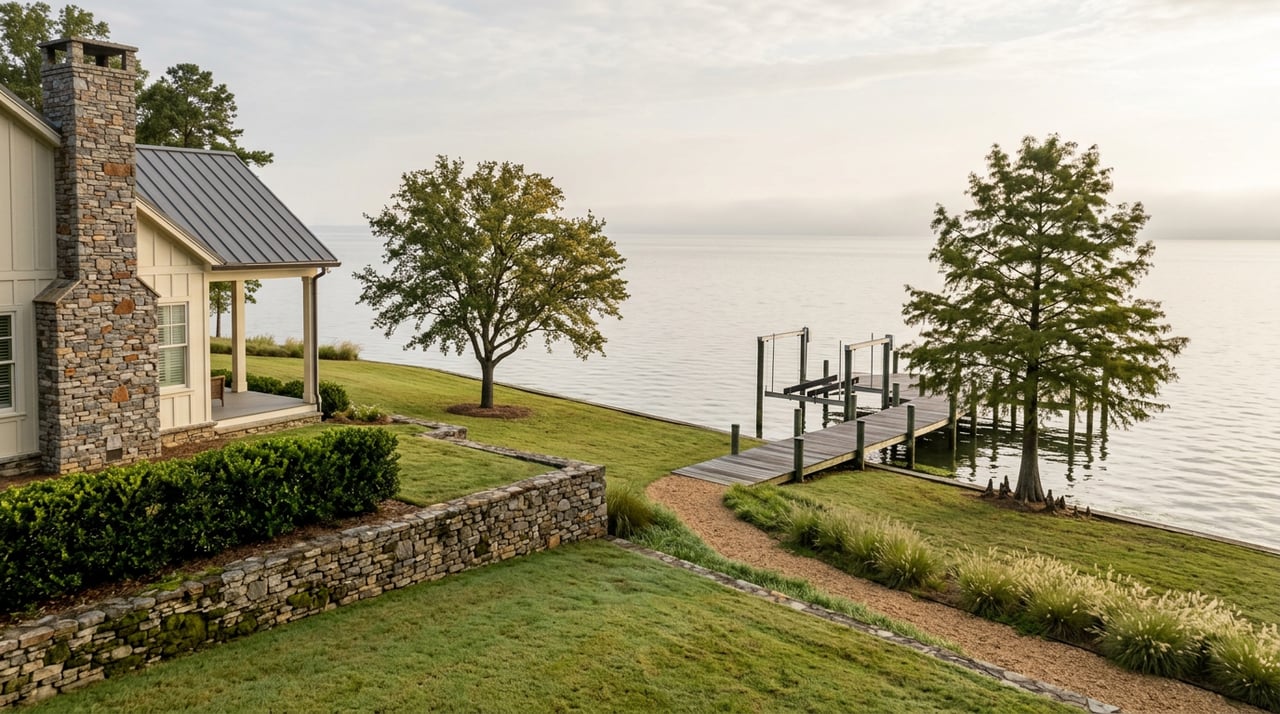
Every waterfront listing on Lake Norman shows the dock. It's usually the second photo, right after the aerial shot of the roofline: a covered slip, a boat lift, maybe a fire pit at the end of the walkway. What that photo doesn't show is that the dock's permit is a separate matter: The Point Owners Association explains that a buyer can apply to transfer an existing Duke Energy permit after purchase.
That distinction sounds like a technicality until it isn't. Lake Norman is a hydroelectric reservoir, built and still operated by Duke Energy under a federal license. The water's edge at full pond elevation of 760 feet above sea level is known as the 760 line, and Lincoln County's code uses that elevation for its Lake Norman dimensional rules. The dock's approval runs on its own track, parallel to your purchase but not bound to it.
For a buyer writing an offer above $2 million, which is roughly where the median Lake Norman waterfront home sat in the first quarter of 2026, that's not a footnote. It's the difference between turnkey lake living and a summer spent waiting on paperwork.
The Permit Doesn't Automatically Follow the Deed
Ask a seller for their dock permit and you'll usually get one of two answers: a copy of the original Duke approval, or a shrug. Duke Energy's Lake Services division will release permit records on request, but only if they're filed under the current owner's name. If the seller never formally transferred a permit from a previous owner, the paper trail dead-ends, and the transfer itself becomes an application you have to file before Duke will confirm anything.
That means the smart move is asking for it before you're under contract, not during due diligence with a closing date already circled. If the seller can produce the permit and it matches what's physically on the water, you're in good shape. If the dock has been rebuilt, resized, or repositioned since that permit was issued and nobody filed the paperwork, you've inherited a compliance question, not a finished amenity.
Before You Modify an Existing Dock
Before modifying an older dock, ask Duke whether the proposed work requires new approval.
The example that trips up more buyers than any other involves roofs. A buyer considering one should confirm Duke's requirements for that specific shoreline before assuming the addition is allowed.
Covered boathouses face the same headwind from the other direction. On many Southeastern lakes, a boathouse is standard. Before getting attached to the idea of a fully enclosed boathouse, the buyer should confirm that it's on the table for their specific shoreline.
Location matters just as much as the structure itself. Lincoln County's code also caps how far a dock can extend into a cove, and the rule is stricter than most buyers expect: a pier facility in a cove cannot extend more than one third of the distance across the cove, measured from the shore at the proposed construction to the nearest point on the opposite shore. A wide-mouthed cove gives a builder room to work.
The Rule That Changed on July 1
Here's the part that even experienced Lake Norman buyers may not have caught yet. As of July 1, 2026, Duke Energy stopped reviewing private dock applications for any lot where no home has been built. That's a direct change to how the agency processes requests, and it lands hardest on a specific kind of buyer: the one purchasing a vacant waterfront lot with a plan to build a house and add a dock once construction wraps.
Under the old approach, a buyer could sometimes get a dock permit moving before the home was finished. Now that sequence is closed. You build the house first. Only then does Duke consider the dock application. If your timeline for lake access was built around getting the dock in place during construction, that plan no longer works, and it's worth confirming with Duke directly before you close on raw land with lake dreams attached to it.
The Math Buyers Skip
Even when a dock permit is straightforward, the timeline rarely fits inside a normal closing window. Duke's initial review for a standard private dock typically runs several weeks, and that's before county building permits enter the picture. Anything involving dredging a shallow cove, adding a second slip, or disturbing wetlands can pull in the North Carolina Department of Environmental Quality and the U.S. Army Corps of Engineers, agencies that operate on their own schedules and don't accelerate for a pending real estate closing.
Duke's initial dock permit application itself carries a processing fee in the range of $850, separate from whatever the actual construction costs once approved. None of this is prohibitive. It's simply slower than most buyers assume, and a 30 to 45 day closing calendar has no room in it for a multi-agency review if your offer depends on being able to build or expand a dock right away.
That's the argument for raising dock approval early in the offer process.
What to Ask For Before You Write the Offer
- A copy of the original Duke Energy permit and any approved site plan for the existing dock or lift.
- Confirmation of whose name the permit is currently filed under, and whether a transfer has already been completed.
- Documentation of any modifications made to the dock since the original approval, and whether those changes were separately permitted.
- The shoreline classification for that specific parcel, since permitted size and configuration vary by location, not by a general Lake Norman standard.
- Written confirmation from the seller or their agent on whether the dock has ever been cited for a violation or subject to a removal order.
- If the lot is vacant, direct confirmation from Duke on current requirements now that dock review is tied to a completed home.
- A realistic accounting of review timelines from every agency your specific project would touch, not just Duke's portion of it.
None of this should scare a buyer away from waterfront property. Lake Norman's 520 miles of shoreline support a genuinely different way of living, and most transactions close without incident once the permit history is clean. The point is narrower than that: the dock is not a fixture like a kitchen island. It's a separate approval, and treating it that way from the first showing protects you far better than discovering the gap during due diligence.
A Few Questions Worth Asking Directly
What approvals should I check for an existing dock? Ask Duke to confirm what applies to the specific dock and shoreline before closing.
What if the seller can't produce any permit documentation? That's a due diligence flag, not an automatic dealbreaker. You can request records from Duke directly, but only for permits filed in the current owner's name, so an undocumented dock often means starting the compliance conversation from scratch rather than confirming an existing approval.
Can I still build a dock on a vacant Lake Norman lot? Yes, but not until a home is built on the property. Duke's July 2026 policy change means vacant-lot dock applications are no longer reviewed, so anyone buying raw waterfront land with dock plans needs to sequence construction accordingly.
If you're looking at a specific address on Lake Norman and want a straight answer on what its shoreline actually allows before you write an offer, Mackenzie Amirfar can help you get the permit history checked and the right questions in front of the right people early. Let's Connect.
This article is general information, not legal, tax or financial advice. Consult a qualified professional about your situation.